• NASA Portal
  • Site Help
  • Feedback
  • Phone Book
Search For:
in
  • HOME
  • OVERVIEW
  • DATA
  • ANNEX
  • DOCUMENTS
  • SOFTWARE
  • PERSONNEL
  • RELATED SITES
  • ABOUT PDS
 
  • Instrument
  • Missions
  • Target/Planet
  • Volume Series
  • Errata

Vega 2

TARGETS

QUICK LINKS

FAQ
Citation Policy
Errata for all volumes
Help for Data Users
Help for Data Reviewers
Help for Data Providers

PDS NODES

PDS Home
Atmospheres
Geosciences
Cartography and Imaging Sciences
NAIF (SPICE)
Ring-Moon Systems
Small Bodies
Management
Vega 2 Archive Page
Vega 2

START DATE : 1984-12-21 ~ STOP DATE : 1986-04


Mission Overview
================
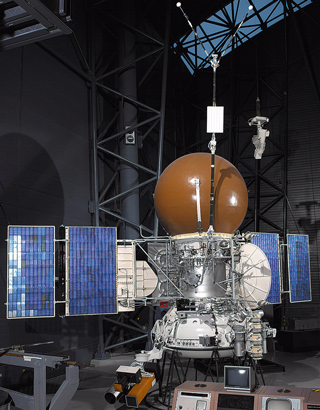
In the late 1970s it was realised that the return of Halley's comet in 1985/86 would provide a unique opportunity to combine a mission to explore Venus, (which had already been planned) with a mission to Halley by employing a two-element space vehicle consisting of a Venus lander (and balloon) and a Halley flyby probe. The mission was called Vega, a contraction of the Russian words `Venera' (Venus) and `Gallei' (Halley) and was conducted by the USSR with a number of other countries withinthe framework of Intercosmos.

The Vega mission comprised two identical spacecraft, Vega 1 and Vega 2. This was a standard approach in the USSR, aimedprimarily at increasing the overall reliability of the mission.
In addition, if both flybys were successful there would be a significant increase in the scientific return, which was particularly valuable in the case of the Halley flybysconsidering the variability of the cometary activity.

The Vega project was truly international. While the spacecraft themselves were controlled by Soviet agencies, the scientific programme and payload were coordinated by the International Science and Technical Committee (CIST), representing scientific institutions and space agencies from nine countries. The CIST designed the Vega mission to be complementary to the EuropeanGiotto and the Japanese Suisei cometary missions.
more ...

×

Vega 2


Mission Overview
================
In the late 1970s it was realised that the return of Halley's comet in 1985/86 would provide a unique opportunity to combine a mission to explore Venus, (which had already been planned) with a mission to Halley by employing a two-element space vehicle consisting of a Venus lander (and balloon) and a Halley flyby probe. The mission was called Vega, a contraction of the Russian words `Venera' (Venus) and `Gallei' (Halley) and was conducted by the USSR with a number of other countries withinthe framework of Intercosmos.

The Vega mission comprised two identical spacecraft, Vega 1 and Vega 2. This was a standard approach in the USSR, aimedprimarily at increasing the overall reliability of the mission.
In addition, if both flybys were successful there would be a significant increase in the scientific return, which was particularly valuable in the case of the Halley flybysconsidering the variability of the cometary activity.

The Vega project was truly international. While the spacecraft themselves were controlled by Soviet agencies, the scientific programme and payload were coordinated by the International Science and Technical Committee (CIST), representing scientific institutions and space agencies from nine countries. The CIST designed the Vega mission to be complementary to the EuropeanGiotto and the Japanese Suisei cometary missions.

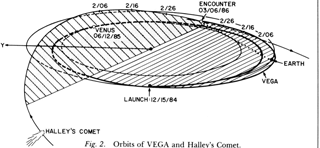
The two spacecraft were launched by Proton rockets from the cosmoport Baikonur on 15 and 21 December 1984, respectively. On 11 and 15 June 1985, the two spacecraft successfully delivered the first balloons into the Venus atmosphere. After deltaV- Venus gravity assist flybys, Vega 1 and Vega 2 encountered cometHalley on 6 and 9 March 1986, respectively.

The interplanetary orbit of Vega 1 from launch to Halley flyby was entirely in the ecliptic. The orbit of Vega 2 was almost identical except for slightly different flyby dates. The plane of Halley's orbit was inclined at 17.8 degrees with respect to the ecliptic. Halley was above the ecliptic from the ascending to the descending node. The flyby speeds were extremely high because Halley's orbit sense was retrograde, that is, directedopposite to that of the Earth and thus of the spacecraft.
During the encounter dust particles impacted on the spacecraft at ~ 80 km/s and caused damage to some experiments and theunprotected solar panels.

The flight operations centre was located in Evpatoria (Crimea), but during the flybys most investigators were in Moscow at the Space Research Institute, where they were able to obtain all the data in real time. Deep space antennas in Evpatoria (70 m) andMedvezy Ozera (64m), near Moscow, received the telemetry.

During the cruise phase the pointing platform was clamped. The clamping mechanism was released on Vega 1 on 14 February 1986 and on Vega 2 on 18 February 1986, and the operation of the TVS and the pointing platform was checked by observing Jupiter and Saturn. The cameras were found to be fully functional. Two days before the Halley encounters the cameras were oriented towards Halley and switched on for two hours. At last, on 6 March 1986, a few minutes before 7:20 UT, for the first time in the history of mankind, the nucleus of comet Halley unveileditself to the human eye.

The second encounter took place almost exactly three days later.
(The most important parameters of both flybys are summarised in the Table below.)

Key data of the Vega mission-----------------------------------------------------------------
Vega 1 Vega 2-----------------------------------------------------------------

launch 15.12.1984 21.12.1984 time of closest approach (UT) 7:20:06 7:20:006.3.1986 9.3.1986
closest approach to the nucleus (km) 8.890 8.030 encounter velocity (km/s) 79.2 76.8 distance of the encounter point from the Sun (AU) 0.7923 0.8341
-----------------------------------------------------------------


Vega mission operations were discontinued a few weeks after the encounters. The general condition of the spacecraft would have allowed further operation. The solar panels were partially damaged by dust impact but could still have provided enough power. The camera performance was tested by observing Jupiter and no essential degradation was registered. Even the amount of fuel onboard was considerable. However, after extensive searches and debates, no interesting object was identified for apossible second encounter.


--------------------------------------------------------------
VEGA scientific payload
Direct Recorded Acronym Experiment Mass Power telemetry telemetry (kg) (W) (bit/s) (bit/20min)
TVS Television 32 50 32768 System IKS Infrared l8 18 2048 4320 Spectrometer TKS Three-Channel 14 30 12288 Spectrometer PHOTON Shield Pene- 2 4 108 tration Detector DUCMA Dust Particle 3 2 100 100 Detector SP-2 Dust Particle 4 4 1024 2160 Detector SP-1 Dust Particle 2 l 150 2160 Detector PUMA Dust Mass 19 31 10240 Spectrometer ING Neutral Gas 7 8 1024 1080 Mass Spectro- meter PM-1 Plasma Energy 9 8 2048 15120 Analyser TN-M Energetic Par- 5 6 512 6480 ticle Analyzer MISCHA Magnetometer 4 6 512 2160
APV-N Wave and 5 8 2048 28080 Plasma Analyser APV-V Wave and 3 2 512 15120 Plasma Analyser-----------------------------------------------------------


--------------------------------------------------------------
Collaborating institutes
Acronym Experiment Collaborating institutes--------------------------------------------------------------
TVS Television LAS, Marseille, France (P. Cruvellier) System Central Research Inst for Physics, Budapest, Hungary (L. Szabo) IKI, Moscow, USSR (G. Avanesov) IKS Infrared Observatoire de Meudon, France(M. Combes) Spectrometer IKI, Moscow, USSR TKS Three-Channel Observatoire de Besancon, Spectrometer France (G. Moreels) IKI, Moscow, USSR (V. Krasnopolskii) Bulgaria (M. Gogoshev) PHOTON Shield Pene- USSR tration Detector DUCMA Dust Particle University of Chicago, USA (I. Simpson) Detector MPI, Lindau, W. Germany IKI, Moscow, USSR Central Research Institute for Physics, Budapst SP-2 Dust Particle IKI, Leningrad, USSR (E. Mazets) Detector SP-1 Dust Particle IKI, Moscow, USSR (O. Vaisberg) Detector PUMA Dust Mass MPI, Heidelberg, W. Germany (J. Kissel) Spectrometer Service d'Aeronomie, Verrieres, France (I.Lertarnsl11(1, Moscow, USSR (R.Sagdeev) ING Neutral Gas MPI, Lindau, W. Germany (E. Keppler) Mass Spectro- Central Research Institute for Physics, meter Budapest, IKI, Moscow, USSR University of Arizona, USA PM-1 Plasma Energy IKI, Moscow, USSR (K. Gringauz) Analyser Central Research Institute for Physics, Budapest, MPI, Lindau, W. Germany ESA Space Science Dept., ESTEC, Netherlands TN-M Energetic Par- Central Research Institute for Physics, ticle Analyzer Budapest, Hungary (A. Somogyi) IKI, Moscow, USSR MPI, Lindau, W. Germany ESA Space Science Dept., ESTEC, Netherlands Nuclear Research Institute, Moscow, USSR MISCHA Magnetometer Space Research Institute, Graz, Austria (W.Redler) Izmiran, Troitsk, USSR APV-N Wave and IKI, Moscow, USSR, (S. IClimov) Plasma Analyser Aviation Institute, Warsaw, Poland Geophysical Scientific Institute, Prague APV-V Wave and ESA Space Science Dept., ESTEC (R. Grard) Plasma Analyser LPCE, Orleans, France Izmiran, Troitsk, USSR---------------------------------------------------------------------

The Planetary Plasma Interactions (PPI) Node of the Planetary Data System (PDS)


Available Data


External Reference

 
  • Reinhard, R and B. Battrick (eds), 'Space Missions to Halley's Comet', European Space Agency ESA SP-1066, ESA Pub Div, Moordwijk, Netherlands, 1986.
  • Privacy / Copyright
    Freedom of Information Act
    Web Master: PDS-PPI Operator
    NASA Official: Becky McCauley-Rench