
MESSENGER
TARGETS
QUICK LINKS

MESSENGER Mission Overview
==========================
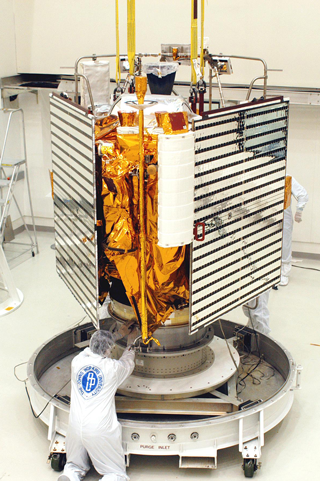
The MErcury Surface, Space ENvironment, GEochemistry, and Ranging (MESSENGER) spacecraft was launched from the Cape Canaveral Air Station on 2004-08-03, on an approximately 8 year mission to become the firstprobe to orbit the planet Mercury.
The MESSENGER payload consists of seven instruments and a radio science (RS) experiment. The instruments are the Mercury Dual Imaging System (MDIS), the Gamma- Ray and Neutron Spectrometer (GRNS), the X-Ray Spectrometer (XRS), the Magnetometer (MAG), the Mercury Laser Altimeter (MLA), the Mercury Atmospheric and Surface Composition Spectrometer (MASCS), and theEnergetic Particle and Plasma Spectrometer (EPPS).
The MESSENGER mission is fully described in[SOLOMONETAL2007].
MDIS
----
The MDIS instrument includes both a wide-angle (WA) and a narrow-angle (NA) camera and both are capable of summing pixels. This provides for images of the surface that are of nearly uniform horizontal resolution (125 m per pixel or better throughout MESSENGER's elliptical orbit). The WA and NA cameras (WAC and NAC) are mounted on opposite sides of a pivot platform, making MDIS the only MESSENGER instrument capable of pointing independent ofspacecraft attitude.
more ...
×
MESSENGER
MESSENGER Mission Overview
==========================
The MErcury Surface, Space ENvironment, GEochemistry, and Ranging (MESSENGER) spacecraft was launched from the Cape Canaveral Air Station on 2004-08-03, on an approximately 8 year mission to become the firstprobe to orbit the planet Mercury.
The MESSENGER payload consists of seven instruments and a radio science (RS) experiment. The instruments are the Mercury Dual Imaging System (MDIS), the Gamma- Ray and Neutron Spectrometer (GRNS), the X-Ray Spectrometer (XRS), the Magnetometer (MAG), the Mercury Laser Altimeter (MLA), the Mercury Atmospheric and Surface Composition Spectrometer (MASCS), and theEnergetic Particle and Plasma Spectrometer (EPPS).
The MESSENGER mission is fully described in[SOLOMONETAL2007].
MDIS
----
The MDIS instrument includes both a wide-angle (WA) and a narrow-angle (NA) camera and both are capable of summing pixels. This provides for images of the surface that are of nearly uniform horizontal resolution (125 m per pixel or better throughout MESSENGER's elliptical orbit). The WA and NA cameras (WAC and NAC) are mounted on opposite sides of a pivot platform, making MDIS the only MESSENGER instrument capable of pointing independent ofspacecraft attitude.
MDIS contributes to the understanding of the geological landforms and processes that shapedMercury's surface.
GRNS
----
The GRNS instrument includes two sensors, a Gamma- Ray Spectrometer (GRS) and a Neutron Spectrometer (NS). The GRS is a germanium detector with an active shield capable of measuring the elemental abundances of O, Si, S, Fe, H, K, Th, and U. The NS sensor consists of two lithium glass scintillators separated by a thick slab of borated plastic scintillator. The glass scintillators measure thermal neutrons, while the borated-plasticscintillator counts fast neutrons.
GRNS contributes to the understanding of surface elemental abundances and the composition of polardeposits.
XRS
---
The XRS detects solar-induced X-ray fluorescence to measure the surface abundances of Mg, Al, Si, Ca, Ti and Fe. Three proportional counters measure low- energy X-rays from the planet, while a Si-PIN detector located on the spacecraft sunshade measures the solar X-ray input. The XRS has a field of view (FOV)of 12 degrees and covers an energy range from 1 to 10 keV.
XRS contributes to the understanding of surfaceelemental abundances.
MAG
---
The MAG instrument is a miniaturized three-axis, ring-core, fluxgate magnetometer mounted on a lightweight 3.6 m carbon-fiber boom extending from the spacecraft in the anti-sunward direction. It samples the field at a 20-Hz rate with selectable readout intervals between 0.04 s to 1 s. Readout intervals of greater than 1 s generate a 0.5 saverage.
MAG contributes to the mapping of Mercury's internal magnetic field and to understanding themagnetospheric structure.
MLA
---
The MLA consists of a 1064 nm laser transmitter and four sapphire lens receiver telescopes. It is capable of measuring altitudes to a 30-cm precision at ranges up to 1000 km. Because of this range, the MLA will operate for about 30 minutes around theperiapsis of each orbit.
MLA contributes to the mapping of the northern hemisphere topography and the altimetry of polar craters and is instrumental in determining Mercury'sgravity field, obliquity and libration amplitude.
MASCS
-----
The MASCS instrument combines a movable-grating Ultraviolet-Visible Spectrometer (UVVS) and a Visible-Infrared Spectrograph (VIRS) into one package. Both instruments share a single front-end telescope. UVVS spans the spectral range from 115 to 600 nm with an average spectral resolution of 1 nm, has a 25 km altitude resolution, and is optimized for measuring very weak exospheric emissions. VIRS measures the visible (300-1025 nm) and infrared (0.95-1.45 um) spectral ranges utilizing a 512 element detector for the visible anda 256 element detector for the infrared.
MASCS contributes to the understanding of the composition of Mercury's surface in association with particular geological units, and to the understanding of neutral species in the exosphereespecially near the polar regions.
EPPS
----
EPPS consists of an Energetic Particle Spectrometer(EPS)and a Fast Imaging Plasma Spectrometer (FIPS).
The EPS measures the time-of-flight and residual energy of ions from 10 keV/nucleon to ~3 MeV and electrons to 400 keV. Its FOV, 160 degrees by 12 degrees, is divided into six segments of 25 degrees each. The FIPS measures thermal and low-energy ions and is sensitive over nearly a full hemisphere, withenergy per charge (E/q) up to > 15 keV/q.
EPPS contributes to the understanding of the solar environment associated with Mercury and itsmagnetosphere.
RS
--
The spacecraft's radio frequency (RF) telecommunications system is for communications, navigation and radio science (RS). Precise observation of the spacecraft's Doppler velocity and range are used to assist in navigating the spacecraft. These observations will be inverted to determine the effect of the planet's gravitational field on the spacecraft. Occultation observations of the spacecraft's RF signal will provide necessary measurements of Mercury's shape in the southernhemisphere.
RS contributes to the understanding of Mercury's gravity field, obliquity and libration amplitude (Doppler observations) and its global topography, especially the southern hemisphere (occultationobservations).
Mission Phases
==============
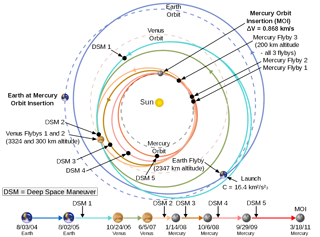
Nineteen mission phases were defined for significant spacecraft activity periods. The large number of phases is due to the complex sequence of gravitational assists necessary to bring the spacecraft into orbit around Mercury while maintaining a minimal mass due to fuel. This consideration lead to one Earth flyby, two Venus flybys, and three Mercury flybys before orbitinsertion at Mercury.
The mission phases are defined naturally by the various planetary encounters and their intervening cruise periods. Given the short encounter times for each MESSENGER flyby, we define encounter phases on the basis of a 4 week period centered on the closest approach to each target body (two weeks before and two after) and separate such encounter segments by cruise phases. The cruise periods and flybys are named according to the planetary body involved. Also definedare a launch and an orbit phase.
The mission phases are: Launch, Earth Cruise, Earth Flyby, Venus 1 Cruise, Venus 1 Flyby, Venus 2 Cruise, Venus 2 Flyby, Mercury 1 Cruise, Mercury 1 Flyby, Mercury 2 Cruise, Mercury 2 Flyby, Mercury 3 Cruise, Mercury 3 Flyby, Mercury 4 Cruise, Mercury Orbit, Mercury Orbit Year 2, Mercury Orbit Year 3,Mercury Orbit Year 4, and Mercury Orbit Year 5.
Launch------
The launch phase has been defined to capture instrument data produced between launch and thebeginning of Phase E.
Mission Phase Start Time : 2004-08-03 (2004-216) Mission Phase Stop Time : 2004-09-12 (2004-256)
Earth Cruise------------
Earth Cruise is the period of time between launchand the week before closest approach to Earth.
Mission Phase Start Time : 2004-09-13 (2004-257) Mission Phase Stop Time : 2005-07-18 (2005-199)
Earth Flyby-----------
Earth Flyby is defined as the four week (28 day)period centered on closest approach to Earth.
Mission Phase Start Time : 2005-07-19 (2005-200) Mission Phase Stop Time : 2005-08-16 (2005-228)
Venus 1 Cruise--------------
Venus 1 Cruise is defined as the period between theEarth flyby and the first Venus flyby.
Mission Phase Start Time : 2005-08-17 (2005-229) Mission Phase Stop Time : 2006-10-09 (2006-282)
Venus 1 Flyby-------------
Venus 1 Flyby is defined as the four week (28 day) period centered on the first of the mission's twoclosest approaches to Venus.
Mission Phase Start Time : 2006-10-10 (2006-283) Mission Phase Stop Time : 2006-11-07 (2006-311)
Venus 2 Cruise--------------
Venus 2 Cruise is defined as the period between thefirst and second Venus flyby.
Mission Phase Start Time : 2006-11-08 (2006-312) Mission Phase Stop Time : 2007-05-22 (2007-142)
Venus 2 Flyby-------------
Venus 2 Flyby is defined as the four week (28 day) period centered on the second of the mission's twoclosest approaches to Venus.
Mission Phase Start Time : 2007-05-23 (2007-143) Mission Phase Stop Time : 2007-06-20 (2007-171)
Mercury 1 Cruise----------------
Mercury 1 Cruise is defined as the period betweenthe second Venus flyby and first Mercury flyby.
Mission Phase Start Time : 2007-06-21 (2007-172) Mission Phase Stop Time : 2007-12-30 (2007-364)
Mercury 1 Flyby---------------
Mercury 1 Flyby is defined as the four week (28 day) period centered on the first of the mission's threeclosest approaches to Mercury.
Mission Phase Start Time : 2007-12-31 (2007-365) Mission Phase Stop Time : 2008-01-28 (2008-028)
Mercury 2 Cruise----------------
Mercury 2 Cruise is defined as the period betweenthe first and second Mercury flyby.
Mission Phase Start Time : 2008-01-29 (2008-029) Mission Phase Stop Time : 2008-09-21 (2008-265)
Mercury 2 Flyby---------------
Mercury 2 Flyby is defined as the four week (28 day) period centered on the second of the mission's threeclosest approaches to Mercury.
Mission Phase Start Time : 2008-09-22 (2008-266) Mission Phase Stop Time : 2008-10-20 (2008-294)
Mercury 3 Cruise----------------
Mercury 3 Cruise is defined as the period betweenthe second and third Mercury flyby.
Mission Phase Start Time : 2008-10-21 (2008-295) Mission Phase Stop Time : 2009-09-15 (2009-258)
Mercury 3 Flyby---------------
Mercury 3 Flyby is defined as the four week (28 day) period centered on the third of the mission's threeclosest approaches to Mercury.
Mission Phase Start Time : 2009-09-16 (2009-259) Mission Phase Stop Time : 2009-10-14 (2009-287)
Mercury 4 Cruise----------------
Mercury 4 Cruise is defined as the period betweenthe third Mercury flyby and Mercury orbit insertion.
Mission Phase Start Time : 2009-10-15 (2009-288) Mission Phase Stop Time : 2011-03-03 (2011-062)
Mercury Orbit-------------
The Orbit phase begins at Mercury orbit insertion and continues until the end of mission. This phase begins the most intensive science portion of the mission with full instrument utilization throughout theperiod.
Mission Phase Start Time : 2011-03-04 (2011-063) Mission Phase Stop Time : 2012-03-17 (2012-077)
Mercury Orbit Year 2--------------------
The Orbit phase year 2 begins the extended mission. This phase continues the most intensive science portion of the missionwith full instrument utilization throughout the period.
Mission Phase Start Time : 2012-03-18 (2012-078) Mission Phase Stop Time : 2013-03-17 (2013-076)
Mercury Orbit Year 3--------------------
The Orbit phase year 3 continues the extended mission. This phase continues the most intensive science portion of the missionwith full instrument utilization throughout the period.
Mission Phase Start Time : 2013-03-18 (2013-077) Mission Phase Stop Time : 2014-03-17 (2014-076)
Mercury Orbit Year 4--------------------
The Orbit phase year 4 continues the extended mission. This phase continues the most intensive science portion of the mission withfull instrument utilization throughout the period.
Mission Phase Start Time : 2014-03-18 (2014-077) Mission Phase Stop Time : 2015-03-17 (2015-076)
Mercury Orbit Year 5--------------------
The Orbit phase year 5 continues the extended mission through to the end of orbital operations. This phase continues the most intensive science portion of the mission with full instrument utilization through near the end of the period which ended whenthe spacecraft impacted Mercury as expected on 30 April 2015.
Mission Phase Start Time : 2015-03-18 (2014-077) Mission Phase Stop Time : 2015-04-30 (2015-120)
The Planetary Plasma Interactions (PPI) Node of the Planetary Data System (PDS)
Available Data
External Reference
|
|
 |
Privacy / Copyright Freedom of Information Act |
 |
Web Master: PDS-PPI Operator NASA Official: Becky McCauley-Rench |